Supported Decision-Making and the Law
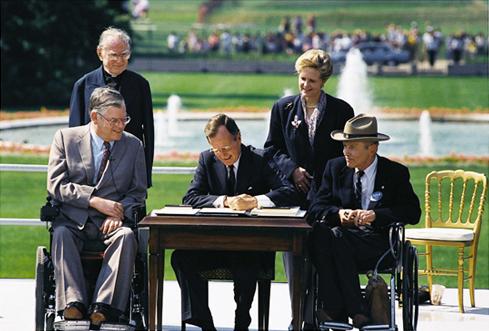
On July 26, 1990, after decades of hard work by disability and civil rights advocates and leaders around the country, President George H.W. Bush signed the Americans with Disabilities Act (ADA). This historical legislation, passed with bipartisan support, guides and enforces the legal rights of people with disabilities to this day.
Since that time, many laws have passed, at both the federal and state levels, that protect and support the legal rights of people with disabilities. Supported Decision-Making laws are one important example of such laws. To date, more than half the states, and the District of Columbia, have passed SDM laws, including Rhode Island.
Supported Decision-Making in Rhode Island
In 2019, Rhode Island passed the Supported Decision-Making Act.
When it passed, following years of advocacy by DRRI and other community groups and individuals, the legislature issued this statement describing the new law.
The law says:
- Adults with disabilities can make a SDM Agreement that names people they trust —called supporters—to help them make decisions.
- Supporters can help people understand their choices, explore options, gather information, make the choice that best for them, and share their decisions with others.
- Supporters cannot make the decision for the person. The person with a disability is always the one in charge!
Why this matters: Rhode Island’s SDM law means that SDM agreements are legal documents. That means that everyone — other people, schools, healthcare providers, banks, employers, and everyone else — should respect and follow them.
What This Means for You
If you are an adult with a disability in Rhode Island, you have the legal right to choose supporters and create a SDM Agreement.
SDM Agreements are recognized as legal documents in Rhode Island, as an alternative to guardianship. SDM is included as one of the less restrictive alternatives that must be considered before another person can seek a guardianship of you.
It’s important to know that SDM Agreements are not the same thing as legal contracts, which are more formal and carry other legal meanings. But SDM Agreements do authorize your supporters to have whatever role you decide they should have and other people must recognize that.
The RI legislature included some important statements about the values and principles of SDM in the SDM law. The law says:
- All adults should be able to choose to live in the manner they wish and to accept or refuse support, assistance or protection.
- All adults should be able to be informed about and participate in the management of their affairs.
- The values, beliefs, wishes, cultural norms, and traditions that adults hold should be respected in supporting adults to manage their affairs.
Remember: SDM is about supporting your decision-making. You are the final decision maker. Your supporters can help, but you decide.
SDM Across the United States
SDM is growing across the country. To date, more than half the states, and the District of Columbia, have passed laws that give SDM legal recognition. Other states are working on new laws or pilot programs.
- Ross v. Hatch, No. CWF120000426P-03 (Va. Cir. Ct. Aug. 2, 2013: First case to ever order supported decision-making as an alternative to plenary guardianship.
- Matter of D.D., 50 N.Y. Misc. 3d 666 (N.Y. Sur. Ct. 2015): A landmark case where the court refused to replace a man’s rights with guardianship because he had a network of supported decision-making and was thriving.
- In re Guardianship of Dameris L., 956 N.Y.S. 2d 848 (N.Y. Sur. Ct. 2012): The court recognized SDM as a way to respect an adult’s decision-making with support.
- In re Peery, 727 A.2d 539 (Pa. 1999): Early precedent emphasized that adults should keep rights unless there is strong proof they cannot decide.
These examples shows that Courts respect people’s right to use SDM to make their own decisions. You can find other cases, organized by state, at www.SupportedDecisionMaking.Org
Global SDM Efforts
Supported Decision-Making is not just in the United States. It’s part of a global rights movement.
The United Nations Convention on the Rights of Persons with Disabilities (CRPD) supports the principle that people with disabilities have the same right to make decisions as everyone else. This is a treaty that was adopted by the United Nations in 2006. The United States signed it in 2009, but has not yet ratified the treaty. More than 170 countries have ratified the CRPD.